AVO LANCASTER MK III ND360
Avro Lancaster.
A short history of the Avro Lancaster.
An Avro Lancaster Mk III such as ND360 was powered by four Packard-Merlin 38 engines,
each rated at 1,390 horsepower, fed through Bendix Stromberg pressure-injected carburettors.
The empty weight of the machine - the structure, power-plants, fuel and oil tanks
(empty) was 31,642lbs (14tons). Added to this the ‘fixed military load’ of 5,169lbs
gave a ‘tare weight’ of 36,811lbs (16.43 tons). In addition the crew, removable
military load, fuel and oil, bombs and carriers added a further (notionally) 28,189lbs
(12.58 tons) to give a gross weight of 65,000lbs or 29.017 tons. Take-off power
is listed as 6,440 bhp.
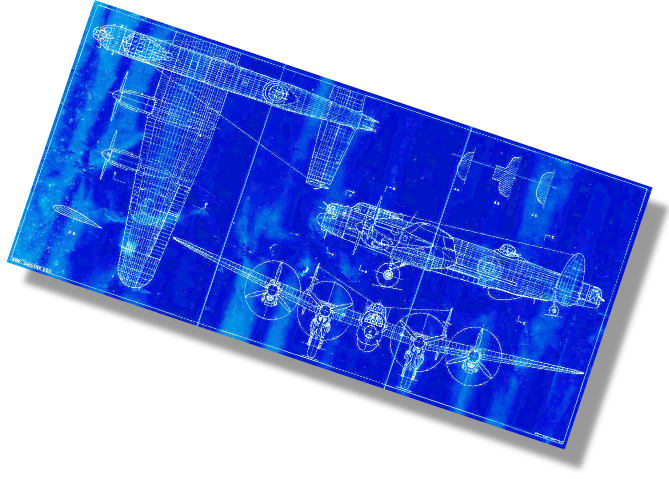
The dimensions of the airframe were:- length 69ft 6in,wingspan 102ft, height 20ft
6in. Rough airspeeds:- cruising 234mph at 21,000ft, 200mph at 15,000ft. The aircraft’s
range varied with bomb load, 2,530 miles with 7,000lb bomb load, 1,730 miles with
12,000lb of bombs. Rate of climb 250ft/minute. Service ceiling 23,000ft, absolute
ceiling 24,500ft, maximum diving speed 360mph.
In reality the range was determined by distances to targets and likely weather conditions,
route variations, fuel and bomb loads. Speeds were notional, being dependant on
altitude, weather conditions, climbing, descending, turning, fuel and bomb loads,
fuel economy, etc. assuming that everything was functioning properly.
The Avro Lancaster’s design was entirely a product of its function, the fuselage
being dominated by the bomb-bay, the wings performed their aerodynamic function and
carried the fuel tanks within and the four power-plants were mounted with their own
‘plumbing’ allowing an engine change to be straightforwardly achieved in five hours
or so. The aircraft had no armour, except for a small plate immediately behind
the pilot’s head. The operators of the machine were arranged on top of and at the
extreme ends of the craft, the greenhouse style cockpit canopy affording excellent
visibility. The most vulnerable spot for a Lancaster was the blind-spot below it,
and the drawback for the crew, reflected by casualty figures, was that it was difficult
to escape from. The forward escape hatch was underneath the bomb-aimer's prone position,
in using the fuselage main door there was a danger of hitting the tail immediately
after baling-out.
In broad terms, the Lancaster had a gross weight of 29tons, a speed of about 200mph
but set in the interests of best fuel economy, and taking into account weather conditions,
wind speed and direction, altitude, climbing or descending, turning or straight and
level flight and a multitude of other factors.
ND360 was from serial range ND324 to NE181 Lancaster Mk IIIs manufactured at the
A.V Roe Chadderton works and delivered to various units during the period December
1943 to May 1944. It was the eighth production batch of 600 aircraft and the third
part of Contract No 1807.
A new Lancaster represented the latest in bomber technology and the development
and fitting of new gadgets and refinements was an ongoing process. One of the major
pieces of equipment being introduced to main force bomber units in December 1943
was H2S air to ground radar which aided navigation and target identification. Up
to recently H2S had been available only to the Pathfinder Squadrons but was now being
fitted in main force aircraft. Such advances in navigation and target finding equipment
allowed RAF Bomber Command to operate in all but the worst weather conditions.
Jim Ives had collected ND360 from RAF Binbrook on 24th December 1943 after it had
been newly delivered by an ATA pilot.
On the Berlin operation of 20th/21st January 1944, ND360's port inner engine was
damaged by flak and while it was in dock for repairs it was kitted out with H2S equipment.
The Lancaster was capable of withstanding significant damage – 100 Squadron pilot
F/Sgt Francis Wadge lost 6ft from the end of the port wing of ED749 as well as incurring
damage to propellers and main-planes in a collision with a night-fighter on the night
of 20th/21st February 1944.
The Luftwaffe was well aware of the Lancaster's blind-spot giving rise to the fitting
of upward-firing pairs of cannon to dispense 'Schrage-muzik' fire from below, aimed
for the fuel-tanks inside the Avro's wings between the two starboard engines ‘and
pulled away immediately without firing at the crew at all’. The standard tactic
for night-fighters with conventional forward firing cannon and machine-guns was the
‘von unten hinten’ method - from below and behind. The night-fighter would make
a radar approach from beneath its target and initially fire at the fuselage to disable
the gunners and/or other crew members. The von unten hinten attack may also have
involved flying beneath the bomber and dropping back to open fire.
The loss of an engine to enemy fire did not adversely affect the handling or capabilities
of the Avro Lancaster, although each engine provided hydraulic power to gun turrets.
Inboard engines also powered pumps and accumulators for the undercarriage, flaps,
bomb doors, carburettor intake covers and fuel jettisoning. The undercarriage and
flap-jacks were of a relatively large capacity ‘it is not normally possible to operate
them by hand-pump in the time available in an emergency’
A compressor on the starboard inner engine charged the pneumatic system air-bottle.
Both inboard engines had a vacuum-pump, one for operating the instrument panel,
one for the bomb-sight gyros. A switch-over cock enabled a faulty pump to be cut-out
from the bomb-sight to instruments. The port inner operated a R A E compressor for
the automatic pilot, MkIV and for the computer.
Each inboard engine had a 1,500 watt generator, connected in parallel, charging the
24 volt aircraft batteries to supply:- usual lighting, propeller feathering pumps,
flap and undercarriage indicators, pressure head heating, fuel booster pumps, radio
equipment, landing lamps, engine starting and booster coils, dinghy inflation, controls
for radiator shutter rams, supercharger gear change rams, idle cut-out rams, bomb-gear
and bomb-sight, fire-extinguishers, fuel contents gauges, fuel pressure warning lights
or gauges, camera, heated clothing, DR panel.
When ND360 was lost it had 72 flying hours 'on the clock'. Only two pilots other
than Jim Ives had flown ND360, F/O Vernon Jones – on the Brunswick operation of
14th January 1944, and F/Lt Ken Major on a fighter affiliation exercise
Various stories abound about Lancaster pilots showing the prowess of their aircraft
against the performance of others by cutting two motors and keeping station with
heavy US bombers

 Contact Me












 More Information
More Information
More Information