Air to air rockets P/O Cyril Kroemer
P/O Cyril Kroemer - Air to air rockets
In 1943 the Luftwaffe adapted the Nebelwerfer 42 rocket for use against Allied bombers,
initially it seems, to disrupt USAAF bomber box formations. The Werfer-granate 21
was hoped to become an even more potent weapon than the Luftwaffe fighters' existing
20mm cannons, with a longer range and a 21cm diameter HE warhead. The earliest known
use against bombers was at the end of July 1943 on the USAAF daylight raids on Kiel
and Warnamunde. The rockets displayed considerable pyrotechnic effect in addition
to their hitting power, but accuracy proved a problem.
Single launch tubes were fitted beneath the wings of Bf109 and Fw190 single-engine
fighters and it is thought that some Me210 Ca-1s had three tubes under each wing,
but these appear to have been used as day-fighters only. The rocket was modified
for use in the air, having a 90lb war-head and being fitted with a time-fuse. However
the launch tubes had to be set with an upward firing angle of about 15° from the
horizontal to allow for the rocket trajectory, which increased the already considerable
drag from the rockets and tubes, with significantly adverse effects on aircraft performance
and manoeuvrability.
In all likelihood on 1st/2nd January 1944, P/O Cyril Kroemer had been fired upon
by a single-engine 'wild-boar' fighter armed with under-wing Werfer-granate 21 rockets.
Wednesday, 5 February 2014
Derek Fenton, youngest brother of F/Sgt Bob Fenton
Derek Fenton, youngest brother of F/Sgt Bob Fenton ('Kiwi') RNZAF, the sole survivor
from
A/W/O J K Ives' 100 Squadron Lancaster ND360 HW-N, shot down on its bombing run over
'the Big City' on 30th January 1944, recalled an occurrence when brother Gordon had
woken in a terrible state having had a terrifying dream about an awful explosion
and horrific fire in the sky. The awful dream came to Gordon on the night of 30th
January 1944 – the brothers saw the significance when the family received the Air
Ministry telegram soon afterwards.
Thursday, 6 February 2014
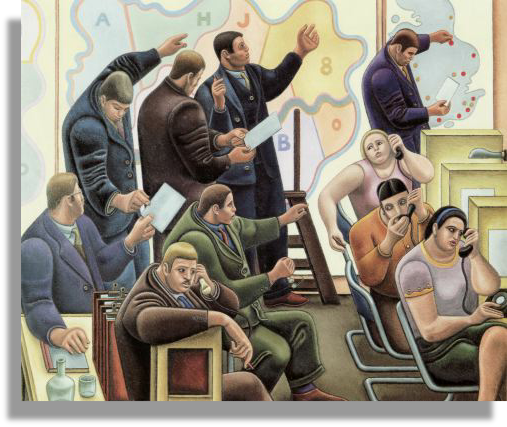
The Control Room, Civil Defence Headquarters' by William Roberts
Posted by John Proctor at 23:17, January 8 2014.
Many thanks to the William Roberts Society for allowing me to display 'The Control
Room, Civil Defence Headquarters' by William Roberts, dated 1941.
According to the Tate Gallery catalogue (1965) - the oil painting on canvas was 'finished
in or by April 1941' - so Jim and Allan would still have been at LCDRHQ when Roberts
was working on it. The painting had been commissioned by the War Artists Advisory
Committee.
Penguin Books used the painting on the cover of their 1960s 'Modern Classics' version
of George Orwell's 'Nineteen Eighty-four'.
This magazine cutting was amongst Jim Ives' effects – it is worth noting the accuracy
of detail of the maps and step-ladder – the 'action' does seem to have been concentrated
when compared against the magazine photo, although during the aftermath of a raid
in the blitz it must have been very busy around the maps. Whilst the figures are
rendered in a 'rounded and friendly' style, the fellow second from the left in the
rear rank has bony facial features somewhat reminiscent of Jim Ives.
Artist William Roberts was born in Hackney in 1895. At the age of fifteen he was
apprenticed at a firm of poster designers/advertisers and embarked on evening classes
at St Martin's School of Art. In 1910 Roberts won a scholarship to Slade School of
Fine Art. He joined Omega Workshops Ltd around 1913, a design enterprise where designers
and artists could produce and sell their own products under the principles of the
Arts and Crafts Movement. Contemporaries at Omega were Roger Fry, Frederick Etchells,
Edward Wadsworth and Percy Wyndham-Lewis among others.
In March 1916 Roberts enlisted in the Royal Field Artillery as a gunner and saw action
on the Western Front. He returned to Blighty in 1918 to become an official war artist
for the Ministry of Information his paintings included 'The First German Gas Attack
at Ypres', 'Burying the Dead After a Battle', 'A Group of British Generals'.
Roberts went on to teach at the Central School of Arts and Crafts in London and in
1922 married Sarah Kramer, the couple producing a son, John. William Roberts developed
a 'Tubist' style of depicting the human form, and specialised in groups of stylised
'tubular' human figures, doing activities, often placed in a London setting. 'The
Control Room, Civil Defence Headquarters' is certainly an example of the format -
where the figures take on the shapes of the backdrop of the maps.

 Contact Me