Blog Archive
If you wish to comment on a post from my archive please email me or post on the
updated blog here..
Monday, 21 April 2014
New main force RAF Bomber Command Film?
'The Dam Busters' is undoubtedly a great film, except perhaps for the water plume
special effects. I saw in the newspaper a couple of weeks ago that the proposed re-make
of the film is no nearer completion – which is perhaps no bad thing.
I have the utmost respect for all those involved in Operation Chastise, and the 1955
movie, however, 55,573 Bomber Command aircrew lost their lives during the Second
World War – surely it is time for a film depicting 'main force' RAF Bomber Command
operations. A British answer to the movie 'Memphis Belle' is long overdue (I am aware
that David Puttnam originally intended the tale to be a Royal Air Force story).
Forgive the pun, but a new Bomber Command film need not set out to be a blockbuster
– what more potential for drama, tension or emotion could there be than in the exploits
of the likes of Norman Lyford, Frank Law, Cy Barton, Frank Wadge and countless others
- devotion to duty and acts of selfless courage were nightly occurrences.
Why hasn't this film been made? Something to do with the elephant in the room – the
ethics of the aerial bombing of cities perhaps?
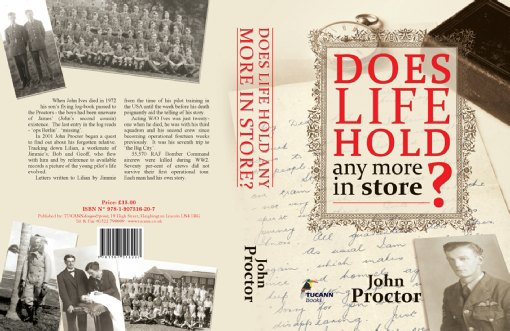
Those of you with a copy of 'Does Life Hold Any More in Store' will know my view
of the proposition that bombing was not only wrong, but could be deemed a war crime.
This may be the philosophical view, but in the context of the progression of the
Second World War - in my humble opinion and as Jim Ives would probably have said
- drivel!
Having been on the receiving end of the 'Blitz', having trained-up air-crews, manufactured
aircraft and ordnance and with no other practicable way of attacking Germany and
its war industries the RAF's aerial bombing of cities was – a 'no brainer'.
The Second World War became 'Total War', where civilians became engaged in the 'war
effort'. I do not accept that the aim of bombing was to kill people. I believe that
the intention was to destroy industries, to de-house workers, to divert resources
away from battle-fronts, to disrupt the lives of the German working population –
to damage the enemy in any way possible.
Lord Cherwell asserted early in 1942 - 'Investigation seems to show that having one’s
house demolished is most damaging to morale. People seem to mind it more than having
their friends or even relatives killed’.
There were certain to be civilian deaths - collateral casualties, as were suffered
in Britain.
Germany had a comprehensive radar-based air-raid warning network, night-fighters,
searchlights, flak batteries, air-raid shelters and the same opportunity as Britain
had exercised to evacuate vulnerable civilians.
Surely, seventy years after the events it is possible to accept that the aerial bombing
of cities and towns was an aspect of 'total war' – it was perpetrated by both sides.
So – how about this new film then? No doubt that it could be stimulating on visual,
cerebral and emotional levels - not to celebrate the bombing of cities – but to acknowledge
that aerial bombing was a feature of the Second World War, and to examine the courage
of our bomber crews (and Germany's night-fighter pilots for that matter).
An honest depiction of bombing operations would lead to a better understanding of
what RAF Bomber Command crews were tasked to do, as 'Das Boot' did for German submariners
– portray wartime servicemen fighting the enemy, the enemy's defences, the elements,
luck and fate.
Sunday, 13 April 2014
Lancaster at War 3, mystery crew page 62
I hope that neither the publishers, nor the authors Mike Garbett and Brian Goulding
will object to me reproducing a photo from their wonderful collection 'Lancaster
at War 3'. Page 62 has two photographs – one depicting Guy Gibson's most famous dog,
the other – an unknown crew from RAF Kelstern with their puppy mascot.
I have it on very good authority that the 625 Squadron crew is that of W/O Ron Lake.
Geoff Yates, B/A in Jim Ives's, and for the rest of his first tour, Donald Blackmore's
crew shared a hut with them. Geoff struck up a rapport with Lake's B/A 'Harpo' Greene
and flew in his stead on a couple of occasions.
Ex P/O Yates (then a F/Sgt) remembered Ron Lake as a steady, cool headed pilot. W/O
Lake went on to complete his tour of operations at Kelstern and survived the war.
Unfortunately I never pinned down who was who in the photo and sadly Geoff is no
longer with us to identify them.
Lake's regular crew form his early days on the squadron seems to have been:-
Sgt R C Lake
Sgt L V Huntingdon (f/e)
Sgt H Greene (b/a)
F/Sgt W H Maver (nav)
Sgt W W Mills (w/op, a/g)
Sgt J Ramsay (a/g)
Sgt A R Masters (a/g)
Presumably one of them was behind the camera. Is there a glimpse of a crown above
the figure on the left's chevron's, if so, and taking into account his dress, could
this be navigator F/Sgt Maver? W/O Lake is next to him.
A/W/O Ronald Charles Lake was elevated to P/O status wef 5th March 1944, the award
of his DFC was gazetted on 19th September 1944.
Unfortunately nothing is known about the dog.

 Contact Me