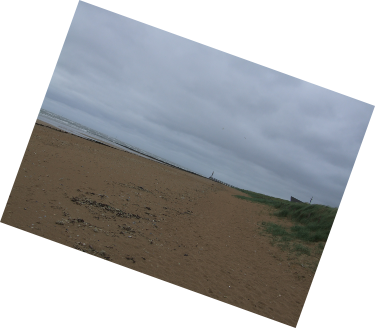
Around halfway between Gold Beach to the east and Sword Beach, which formed the left-hand
flank of the D-Day Landing beaches, is Juno Beach. Here, the Canadian 3rd Division
came ashore, later than the other landings due to natural off-shore shoals and reefs.
When the first assault landed at 07:55 the tide was rising and the beach obstacles
were partially submerged, making it difficult for the engineers to clear the way
and leading to problems in landing.
Around 30% of the landing ships at Juno were destroyed or damaged by mines on the
beach and once the troops began moving inland, the German guns took a terrible toll.
However, in spite of facing heavy and fierce opposition at Courselles-sur-Mer, the
Canadian forces broke through to take the towns of Bernières-sur-Mer and, later,
Saint-Aubin with armoured units making there way towards the Caen-Bayeux road.
By evening, Canadian troops had linked up with British troops from Gold Beach to
the west, but there was still a gap between the Canadians and the British forces landing
on Sword Beach to the east.
This allowed the Germans to orchestrate a counterattack by the 21st Panzer Division.
Bunkers can still be found today along Juno's coastline, in particular the bunker
outside of the museum, the Juno Beach Centre.
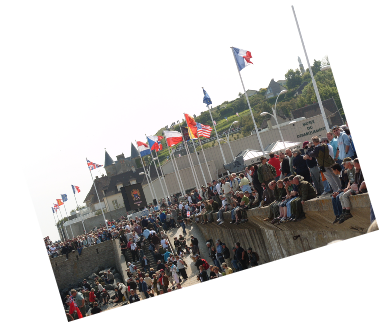
Dedicated to showcasing the Canadian involvement in WW2 at Juno Beach, the museum's
courtyard features a memorial entitled Remembrance and Renewal by Canadian sculptor
Colin Gibson.
The Maison de Queen's Own Rifles, a house on the beach which was possibly the first
house on French soil to be liberated by the Allies, is today a memorial to the Canadian
Queen's Own Rifles who liberated it in the first wave of attacks on June 6th 1944.
The house appeared in many of the official photographs and newsreels of the landings.
 Contact Me