
Copyright jcproctor.co.uk 2014 Links
Text and images from this site can only be copied or reproduced elsewhere, digitally on websites or in print with written permission of the site owner
Winter 1943/44 'Battle of Berlin', RAF Bomber Command, Arnold Scheme pilot training 1942, 55,573 aircrew were killed during the second world war, Research, 625 Squadron RAF Kelstern, 626 Squadron RAF Wickenby, 100 squadron RAF Waltham, research into RAF Bomber Command operations. Berlin op 30th/31st January 1944. WWII Pilot A/W/O James Kenneth Ives RAFVR.
- WWII RAF Bomber Command.
- 625, 626 and 100 Squadrons.
- Book -
'Does Life Hold Any More in Store?' - If you recognise a name please contact me.
WWII Bomber Command RAF

This page is dedicated in honour of
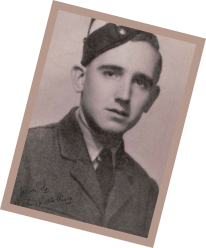
F/Sgt Harold William Powter
Harold William Powter
As with so many of the airmen who were Jim Ives' contemporaries Harold Powter's luck
eventually ran out. Having completed a tour of operations with the 625 Squadron
crew of Canadian pilot P/O Reginald Price DFC, Harold Powter did not lose his life
over enemy territory, but tragically, during relaxation time not far from his London
home. It seems that Harold was attending a party which received a bomb strike, likely
to have been a V1 'flying-
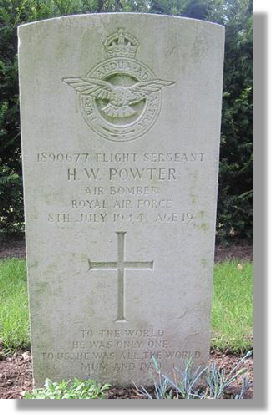
Harold died on 8th July 1944 and was subsequently interred in Edmonton Cemetery sec.
W grave 13. His name appeared in the casualty lists published in ‘The Aeroplane’
magazine of October 27th 1944 as having ‘died of wounds or injuries received on
active service’ -
Harold William Powter was born in the third quarter of 1924 to Herbert William and Violet Beatrice Powter his birth being registered in Edmonton, North London. Harold was the eldest of four children, his younger siblings were Donald, born in 1928, Betty, 1933 and the youngest, Molly in 1939.
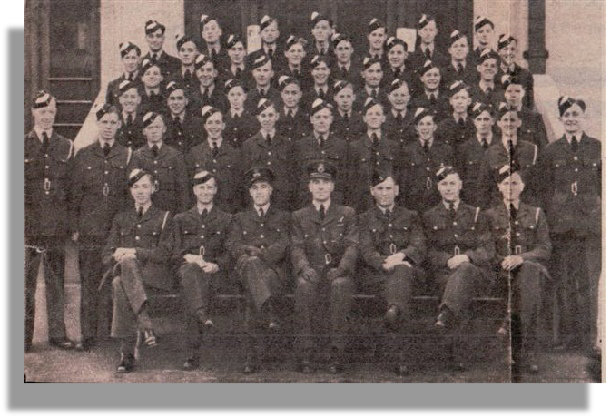
A photograph from a magazine depicting a muster of air-
(second left – back row, extreme left, others – possibly either side of Harold, fourth row?)

Having completed gunnery training Sergeant Powter advanced through OTU and 1667 Conversion Unit
(RAF Lindholme) in August 1943, becoming a member of Sgt Reginald Price's crew along the way. On 15th October 1943 Sgt Price's crew arrived ta their first operational posting, brand newly formed 625 Squadron stationed at RAF Kelstern on top of the Lincoln Wolds.
Price's crew were:-
pilot F/Sgt R W D Price RCAF
flight engineer Sgt L A Knowles
navigator F/Sgt D H Ball RAAF
bomb-
wireless operator/ air gunner Sgt J H G Harris
mid-
rear gunner Sgt F Sutton
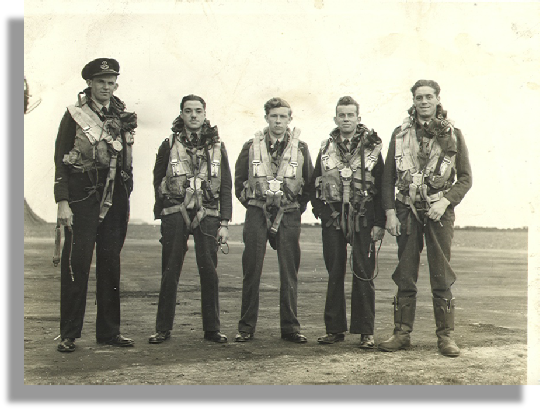
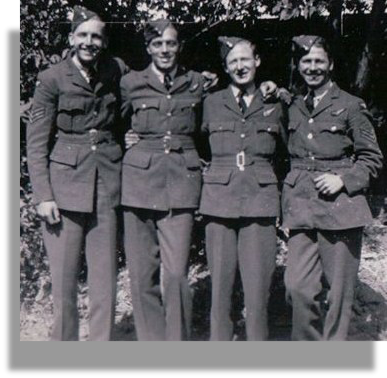
(Dudley Ball, Les Knowles, Reg Price, Jack Conley, Frank Sutton (Jim Harris and Harry Powter absent!)
The crew would stay together over the next seven months to complete their tour of operations in May 1944 on their return from the Lyons raid on the first of the month.
The crew's devotion to duty was recognised in the award of the Distinguished Flying
Cross to their skipper. The citation for Reginald Price's DFC and supporting comments
by Officers up the chain of command can in all fairness be applied to his crew as
well:-
'This Canadian Pilot Officer has completed 31 sorties comprising 213 operational flying hours as captain of a Lancaster aircraft. He and his crew have attacked many major targets including Leipzig, Stettin, Schweinfurt, Stuttgart, Frankfurt, Essen and many others including no less than eight sorties over Berlin.
Throughout a most arduous tour of operations this officer has displayed fine qualities of airmanship as was clearly demonstrated one night in November when, shortly after take off with a full bomb load and at a height of only 300 feet, both port and starboard inner engines failed, one engine catching fire.
Pilot Officer Price in a cool and skilful manner, feathered the propellers of these engines, extinguished the fire and, maintaining height with great difficulty, proceeded out to sea where, after jettisoning equipment and incendiary bombs, he was at last able to reach sufficient height to drop his high explosive bombs with safety. Pilot Officer Price then returned to base and made a successful landing without damage to his aircraft or injury to his crew.
This officer has carried out his tour of operations displaying quiet persistence and a cool, determined endeavour over a long period, sometimes under most trying circumstances, and for the success he has achieved I consider he fully deserves an award of the Distinguished Flying Cross.'
The Officer Commanding, RAF Station Kelstern, added on 14 May 1944:
'After a number of set backs at the beginning of his tour, this officer has proved to be a most reliable aircraft captain. Under a quiet manner he has displayed fine qualities of determination and is strongly recommended for an award of the Distinguished Flying Cross'.
Harold flew the 20th October sortie with Jim Ives' crew, filling in at the last minute for the absent F/Sgt Allan. The sortie was abandoned and so did not count as a full operation.
The Price crew's operational record is as follows:-
20 Oct 43 Leipzig 15 Mar 44 Stuttgart
22 Oct 43 Kassel 18 Mar 44 Frankfurt
18 Nov 43 Berlin 22 Mar 44 Frankfurt
22 Nov 43 Berlin 24 Mar 44 Berlin
26 Nov 43 Berlin 26 Mar 44 Essen
1 Jan 44 Berlin 30 Mar 44 Nuremburg
2 Jan 44 Berlin 10 Apr 44 Aulnoye
5 Jan 44 Stettin 11 Apr 44 Aachen
14 Jan 44 Brunswick 20 Apr 44 Cologne
20 Jan 44 Berlin 22 Apr 44 Dusseldorf
27 Jan 44 Berlin 24 Apr 44 Karlsruhe
19 Feb 44 Leipzig 26 Apr 44 Essen
20 Feb 44 Stuttgart 27 Apr 44 Friedrichshaven
24 Feb 44 Schweinfurt 30 Apr 44 Maintenon
25 Feb 44 Augsburg 1 May 44 Lyons
1 Mar 44 Stuttgart
Similarly to the Ives crew Sgt Price had a difficult start to operations:-
3rd November -
This had been a 'dicey-
26th November Lancaster W4993 Target Berlin. Up 17.20 dn 00.50hrs 'Target bombed at 21.19 hours from a height of 21,000 feet. Aircraft coned. Four thousand lb bomb jettisoned as electrical discharge and manual release failed over target. Floor cut away to remove bomb.
2nd January 1944 Lancaster JB122 Target Berlin. Up 23.35 dn 08.45 hrs. 'Target
bombed at 02.54 hours from a height of 20,000 feet. Wanganui flares were put down
regularly and in fair concentration. Mid-
Harold Powter, the midupper gunner obviously had a very close shave – flak shells
burst to create flying shrapnel splinters -
28th January 1944 Lancaster ME594 Target Berlin. Up 00.04 dn 03.44hrs. 'Task abandoned at 01.45 The port outer engine became u/s and could not climb more than 16,000 feet. Bombs jettisoned safe in the Sea.'
30th January 1944 Lancaster ND407 Target Berlin. Up 17.13 dn 19.45hrs. 'Task abandoned owing to 6lbs boost surge on all four engines in “S” gears. Methods were resorted to with a view to rectifying this surge, but with no success.'
From January 1944 to the end of March German defenders gained the upper hand against
the RAF bombers, culminating in the loss of over ninety aircraft in the ill-
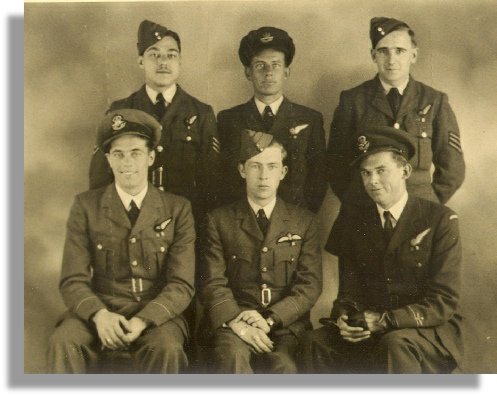
At the end of their operational tour the crew were posted as follows:-
F/Sgt Harold Powter and P/O Francis Sutton to 30OTU w.e.f. 20th May 1944
F/Sgt J H G Harris to 1667CU w.e.f. 20th May 1944
Sgt LA Knowles to 1662CU w.e.f. 20th May 1944
P/O J Conley to 1662CU w.e.f. 22nd May 1944
P/O D E Ball to 1662CU w.e.f. 22nd May 1944
P/O R W D Price to 82OTU w.e.f. 20th May 1944
Over the duration of Harold's tour, between mid-
It is thought that nineteen year-
Further research has uncovered the details of the tragic story of Harold's death,
I am indebted to Leslie Cole and Stephanie Cole, and thanks also to Joe for the press
cuttings which provided the clues to what happened and where and gave more pointers
to Harold's life before the RAF. The scant details in the Powter family lore were
not at all far from what actually happened – there had been a pre-
By the 8th July 1944 Adolf Hitler's vengeance weapon the V-
The Price crew's first operational sortie as a crew had been against Kassel on 22nd
October 1943. One of the major targets here was Gerhard Fieseler Werke a major aircraft
producer with three factories in Kassel. Fieseler produced Fw190 aircraft and were
heavily involved in the development of the V1 ‘retaliation weapon’. Less than nine
months later Harold Powter would be killed in a V-
'Surviving a Direct Hit from a V1 'Doodlebug' -
During the day of the 6th July, 1944 it had been raining all day long, and the Dickinson's Anderson shelter was flooded, consequently the following night saw the two Dickinson brothers sleeping under a big oak table in the front room of their home at 34 Carpenter Gardens.
That night a V1 flying-
Michael recollects that -
'Fire was raging everywhere as gas mains exploded, and we could hear the incessant screams of very badly injured friends and neighbours'.
The Dickinsons were able to escape to their garden as the rear wall of their house had collapsed and was 'completely open to the heavens'.
The Dickinson brothers fortunately only sustained minor injuries, their mother had a bad injury to her leg which warranted admission to hospital (their father was away on Army service). Before leaving for hospital however, Mrs Dickinson went back into the house to retrieve the bag of family photos she had left inside. Minutes after coming back outside the house collapsed completely.
The fire and ARP rescue services were soon at the scene and the boys were taken to
a local church which had been requisitioned as a rest centre for those made homeless
-
Harold Powter was indeed a victim of the V1 'flying-
On Friday July 7th Harold was enjoying a 48hr pass from his posting as an instructor
at 27OTU, visiting family and friends in the Enfield area. That evening he was due
to go and see his girlfriend Doreen at her parents' home at 32 Carpenter Gardens,
Winchmore Hill. Doreen's family were preparing for the forthcoming wedding of her
brother Leslie and his fiancée Lily arranged for later in July. Doreen had just
taken delivery of her bridesmaid's dress and was looking forward to showing it off
to the family and Harold. Also in the house were father and mother -
Harold had not initially intended to stay the night at number 32 but as Leslie was not at home, his bed was available and so Harold decided to stop over.
The V1 bomb exploded in the front garden of 32 Carpenter Gardens at around 11pm.
William Cole, Doreen’s father, was at the front door of the house, possibly trying
to watch the progress of the 'buzz-
When the 'Doodlebug' exploded, Doreen, her grandmother and her father were killed outright. Philip and Harold were blown through the roof, both sustaining serious injuries. Kathleen survived without serious injury.
Next door in number 34, husband and wife Henry and Jane Chamberlain were killed and their daughter lost both legs, their other daughter was away serving in the ATS.
At 36 Carpenter Gardens John Pretlove, 52, and his son Ronald, 16, were killed, as
were Edith Pretlove, 26, wife of RN Stoker Reginald H Pretlove and their two-
Following the blast, Harold Powter and Philip Cole were taken to hospital where Harold died later, but thankfully Philip survived (although with long term consequences). As his older brother Denis was serving abroad, Leslie was given compassionate leave and sent home to deal with the aftermath of the bombing, deaths and loss of home. He visited Philip and Harold in hospital and subsequently went to Harry's funeral on 14th July.
What a terribly sad and tragic event this was. The V-
Harold's death and funeral were reported by the local newspaper, revealing more about
Harold's life before the RAF. It is apparent that the local press were constrained
as to how much they could say about the circumstances of Harold's death. That a
serving RAF airman had been killed by one of Hitler's revenge weapons could have
potential for a German propaganda coup if the story was somehow picked up by the
enemy -
Harold had been an old boy of Chesterfield Road and George Spicer Schools in Enfield.
He went on to work in 'a government factory' -
Present at the funeral service were members of Harold's crew -
status in mid-
While working at RSAF Harold also fulfilled responsibilities in support of the war
effort and his local community – as a part-
There were almost 1.5 million ARP wardens in Britain during the war, almost all unpaid
part-
In the run-
patrolling from their local Wardens’ Post to report damage caused by air raids to a control centre from which specialist services – Fire, Rescue and First Aid Parties were mobilised to help.
The Warden Service in London was controlled by the London Boroughs (outside London
wardens came under the auspices of the Police). Each London Borough was headed
by a Chief Warden who was responsible to the Head of ARP in his area for all aspects
of the Warden Service. Below the Chief warden extended a hierarchy of district and
post wardens. The trained warden was allocated to his Wardens’ Post run by a Post
Warden (Senior Warden, as they were known outside London). A number of posts – usually
between three and twelve – formed a Group under a Head Warden with larger towns divided
into Divisions with a Divisional Warden. In the case of area 'F' the hierarchy was:
Mr Miles -
Most wardens were unpaid volunteers although a small number were paid full-
Air Raid wardens had the task of patrolling the streets during the black-
It was reported that Harold had been a member of 36 ATC when it was still ADCC (Air
Defence Cadet Corps) which was set up in 1938 by Air Commodore Sir John Chamier with
the intention of training young men in various 'aviation-
By 1941 the ADCC had proved so popular that it was granted the Royal Warrant and
became the Air Training Corps with a function of giving part-
The Gazette also reported that while in the services Harold had gained a good reputation
as a footballer and cricketer and that he was known to his friends as 'Harry'. There
had been a funeral tribute from Area F Sports Section and one from 'The Boys', RSAF,
it was stated too that 'Judging by the large following Harold was obviously well-
Reference was also made to neighbours and friends from Tottenhall Road. The family
of Emma Irish was well acquainted with Harold's mother's family – the Smiths – they
had been neighbours in Tottenhall Road, Wood Green from 1918 until 1937 or thereabouts.
When Herbert Powter and Violet Smith were first married they lived with Violet's
parents at 21 Greenbrae, Tottenhall Road, where Harold spent his first months -
It was indeed a cruel irony that Harold died as a result of bombing, especially having
completed his tour of operations. Doubly tragic as he and his crew-
Unfortunately 'there is no armour against fate' and Harold was in the wrong place at the wrong time.
Violet Powter was so distraught at the death of her eldest son her family were sure
that it caused rheumatoid arthritis to set in which ultimately led to her being wheelchair-
Harold's headstone bears the additional inscription -
John Proctor
Many thanks for the information and photos to Harold's nieces Janet Hornby and Linda Wisbey




Active Viewers Online

| Intro Video |
| Home Page |
| About Me |
| About My StainedGlass |
| Buy The Book |
| About My StainedGlass |
| Gallery Stained Glass |
| Blog |
| John Proctors Blog Archive |
| Facebook Jcproctor |
| Research |
| Real WWII Stories |
| Dedicated Honour Pages |
| Image Gallery |
| Radio Interview |
| Research List 1 |
| Research List 2 |
| Research List 3 |
| Research List 4 |
| Research List 5 |
| Research List 6 |
| Research List 7 |
| Losses List 1 |
| Losses List 2 |
| School List |
| School Memorial Work |
| Jims Posting's |
| Submit A Story |
| WWII 625 Squadron Stories |
| WWII 626 Squadron Stories |
| WWII 100 Squadron Stories |
| WW2 Related Stories Three counties area Do you have a WWII Story? |
| Gallery Airmen |
| Gallery Can You Identyfy |
| Gallery Site Images |
| Media Pages |
| Video Room |
| Gallery |
| 1944 Audio BBC D Day Landings Audio |
| AVRO LANCASTER MK III ND360 |
| D-Day Places To Vist 70th |
| Good Causes |
| Downloads |
| Gallery D-Day Celebrations |
| Arromanches/Gold Beach |
| Sword Beach |
| Omaha Beach |
| Juno Beach |
| Utah Beach |
| Pegasus Memorial |
| Batterie de Maisy |
| Mont St Michel |
| Links |
| Contact |
| Guest Book |