During the Second World War young men came from all walks of life to give themselves
up to the armed forces for the duration of hostilities. For many the desire to fly
aeroplanes drove them to the Royal Air Force to join pre-war regulars in the newest,
untested branch of the services. Young men left professional occupations to retrain
as fighting men and, with luck, survived and worked their way up to positions of
responsibility where their leadership inspired those around them.
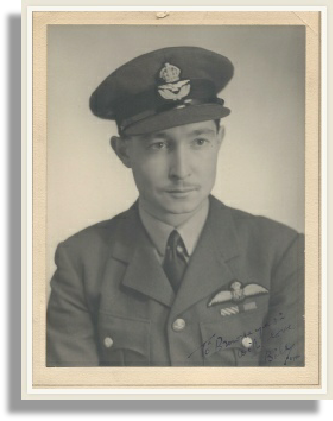
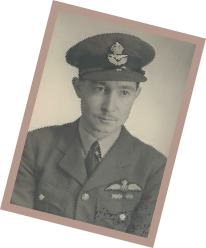
Acting Squadron Leader Josiah Lewis Spiller was just such a man. As with many of
his generation, having survived the war in a most hazardous occupation – flying operations
for RAF Bomber Command, 'Bill' Spiller resumed his pre-war profession and hardly
ever spoke of his wartime experiences. His son David recalls that until his father's
death all he had known was that Bill had been in the RAF. David can recall his father
only ever saying two things about the war; the first was in reply to ten year old
David's question - 'What did you do in the war Daddy?' His reply - 'It was awful!'
- that was it.
The other occasion was when David and his father had been to see the film 'The Great
Escape'. They were walking back to the car in the dark and Bill said 'You know,
I knew three of those chaps who were shot. The Germans were complete b-----ds' (fifty
of the escapers had been rounded up and shot in a field). Again, that was all.
It was not until after his father's death in 1986 that David found log-books, medals
and some photos hidden away.
Josiah Spiller had joined the RAFVR sometime in 1939 and his commission to Pilot
Officer on probation from LAC rank, effective from 14th January 1940 was gazetted
on 6th February of that year. He served in various bomber squadrons as an air-gunner
between 27th January 1940 and 4th October 1941 during which time he was promoted
to F/O in January 1941 and flew a total of 28 operations and 169 other flights and
exercises.
Bill Spiller then went to Canada for pilot training.
Having already filled one flying log book F/O Spiller started entries in his second
log in mid-December 1941, he was elevated to F/Lt status with effect from 14th January
1942.
F/Lt Spiller's next log book runs from 15th December 1941 until 7th January 1943
and the next from January 1943 to June 1945. In these two log books he flew a total
18 operations between 22nd September 1943 and 22nd March 1944.
On 29th/30th September 1943, having taken-off from Oakington at 18.41 Lancaster JB225
returned early with engine failure and crash-landed at Swanton Morley airfield at
21.37 the 7 Squadron crew comprised:- F/Lt J L Spiller, Sgt F J J Kofoed, F/O C
Barnes, Sgt A C B Halvorsen, Sgt A A Tucker, Sgt G E Armstrong, Sgt H E Jacobs –
to the pilot's great credit no injuries were sustained. There were a couple of hundred
other flights, amongst which was an exercise flown at 625 Squadron with Jim Ives
on 5th November 1943, details of which are given as:-
Date: Nov 5 1943/ Aircraft: Lancaster III 'K'4993 / Pilot: Self / 2nd pilot,Pupil
or Passenger:
F/Sgt Ives, P/O O'Dea, F/Sgt Hodges, F/Sgt McKean, Sgt McLeod/ Duty: Fighter Affiliation
(F/O Bentley was this crew’s regular navigator, not apparently required on a fighter
affiliation exercise).
The crew flying with F/Lt Spiller on this occasion had previously served with 100
Squadron. In mid-June 1943 they had been flying with pilot Sgt L H Wright when their
aircraft was badly shot-up by a Ju88 and crash-landed back at Grimsby. Sgt Robinson
was f/e on that occasion and was apparently injured in the crash-landing. The crew
was posted to 625 Squadron as part of the contingent from 100 Squadron's 'C' Flight
which constituted the heart of the new squadron at RAF Kelstern.
Pre-war skills and training from 'civvie-street' were, where possible, utilised on
the squadron – Bill Spiller's legal training came in useful in helping to administrate
paperwork connected with disciplinary matters.
For example, in the case of Jim Ives's air-gunner F/Sgt William Allan's short, but
not insignificant absence without leave from RAF Kelstern, F/Lt J L Spiller was engaged
to take statements from the parties affected by Allan's absence:- S/Ldr Canham, F/Sgt
Ives, W/O Johnson and F/Sgt Allan on 26th October 1943.
Allan refused to sign his first statement - all he would say was that he had stayed
overnight in Grimsby and had intended to catch the 07.30 workers' bus back from Grimsby
but had overslept. At the subsequent Court Martial hearing William Allan chose not
to give evidence on his own behalf, nor to call any witnesses in his defence but
he did submit a more comprehensive statement which outlined the events, seemingly
at the suggestion and wise counsel of F/Lt Spiller. It is probably thanks to Bill
Spiller's advice that, despite being found guilty, F/Sgt Allan retained his Sgt's
chevrons and did not lose his Air Gunner's brevet (which would have been the case
had he been demoted to LAC).
F/Lt Spiller and his crew -
Sgt Henderson F/E
P/O O’Dea RAAF B/A (who also flew as ‘second pilot’).
Sgt McCleod Wop/ Ag
F/Sgt Hodges M/U
and F/Sgt John McKean RAAF R/G
were posted from 625 Squadron to RAF Wickenby on 5th December 1943 where F/Lt Spiller
took command of newly formed 626 Squadron's ‘A’ Flight.
'Bill' Spiller is mentioned in Sqn Ldr Jack Currie's memoir 'Lancaster Target' At
the end of his 'tour' with one operation left to do Currie was expecting to finish
with a 'milk run' to a relatively 'easy' target and was somewhat miffed when himself
and his crew appeared on the battle order for the attack on Berlin on 28th January
1944. Jack Currie intended to have it out with 'Bill' Spiller who suggested that
it would be better to get it over with rather than 'hanging around waiting for their
last op getting more and more jittery'. Berlin was to be an early (7.00pm) take-off,
'you'll be home by three, and you're finished before you've had a chance to worry
about it.'
All went well for the Currie crew and as predicted they landed in the early hours
of the morning and a crate of beer was waiting for them, courtesy of Flight Commander
Sq/Ldr Spiller.
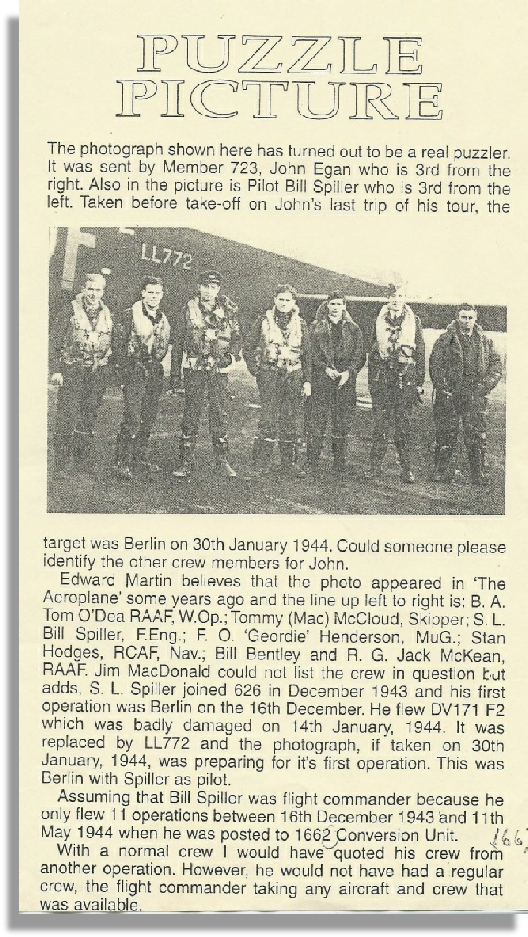
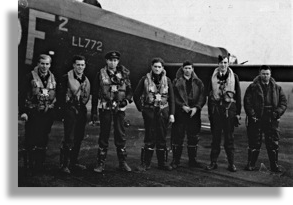
Sq/Ldr Spiller's crew was on the battle order for the next operation to Berlin on
30th January.
Recourse to Squadron records confirms that the crew accompanying Sq/Ldr J L Spiller
in LL772 on 30th January was predominantly his regular crew, personnel as noted in
the article but with the exception of mid-upper gunner John Egan who on that occasion
filled in for F/Sgt Hodges.
The gracious award of the Distinguished Flying Cross by His Majesty the King to Acting
S/Ldr J L Spiller of 626 Squadron was gazetted on 18th April 1944.
Bill Spiller's last day of service, as entered in his Service and Release Book was
13th November1945.
After the war Bill Spiller resumed his studies and career as a solicitor with the
Lee Conservancy Catchment Board.
The River Lea, a main tributary of the Thames, was used for many hundreds of years
as a transportation route, for the extraction of water for settlements along its
course, for fishing and drainage. Major works to canalise the Lea were undertaken
from the late 1760s and for the next hundred years or so to create the Lee Navigation
which extended from Hertford to Limehouse Lock in the heart of London. In the 1930s,
130-ton barges could reach Enfield and 100-ton barges ran from the Thames to and
from Ware and Hertford. The management of the Navigation and its catchment area
was undertaken by The Lee Conservancy Board.
The Lee Conservancy Catchment Board, a separate entity from the Lee Conservancy Board,
was established under the Land Drainage Act 1930 having responsibilities for various
functions relating to water supply, fisheries, pollution and flood control and drainage
in the catchment of the Lee Navigation. By the late 1940s Bill Spiller held the
position of Clerk of the Board with significant responsibilities - including for
the preparation and submission of Bills for Acts of Parliament controlling the Conservancy
Catchment Board, together with the wide range of legal functions necessary for the
administration of the Board's duties.
David Spiller remembers his father as 'a very kind, quiet, academic sort of fellow'...'I
never had any idea that he had been through such hell, but I am very proud of him'.
John Proctor
 Contact Me